Felix Czwielong
Aerodynamic and Aeroacoustic Interaction of Heat Exchangers and Low-Pressure Axial Fans

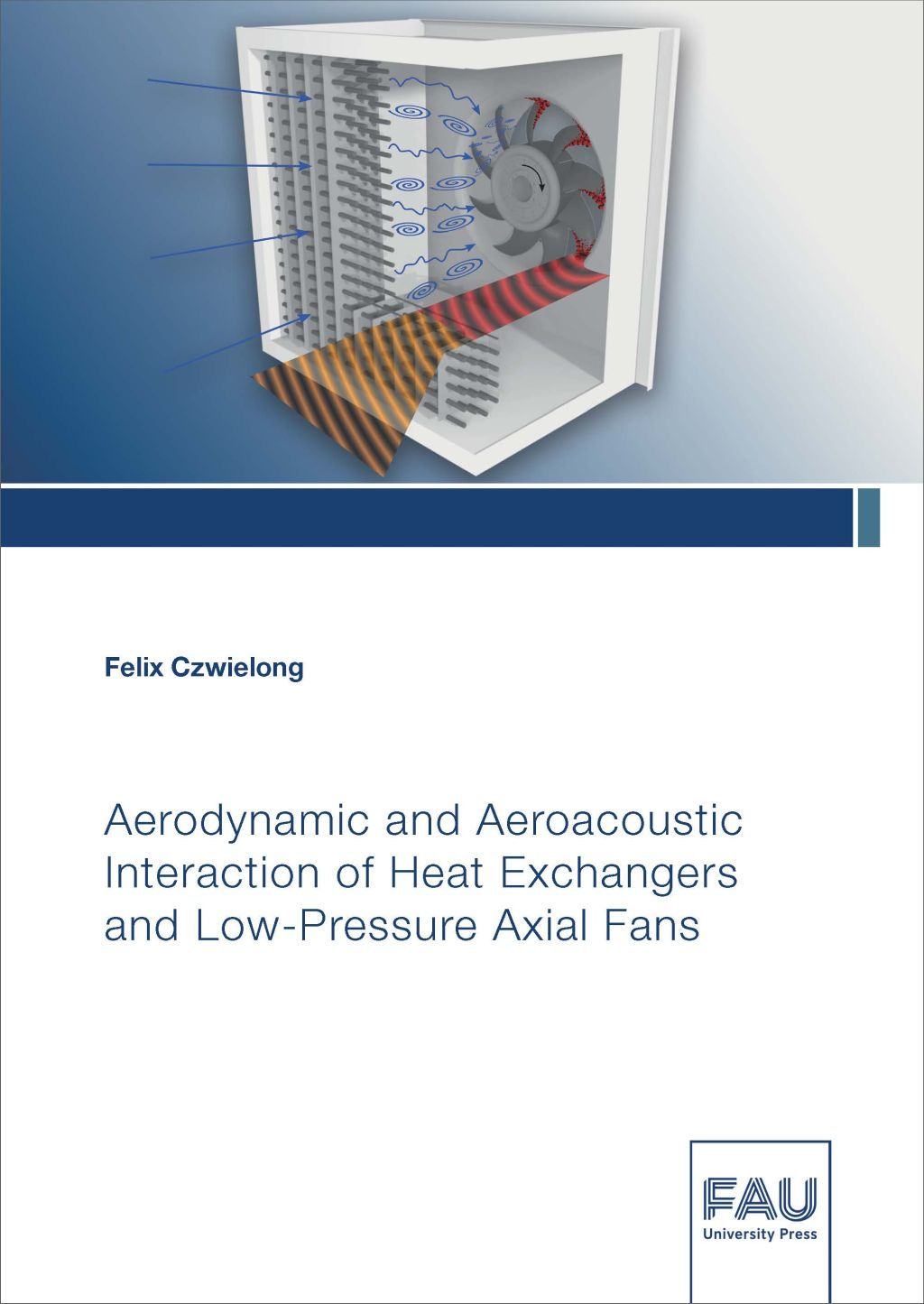
The sound emission of axial fans in heat pumps and air conditioning systems has not yet been sufficiently addressed and contributes to the reduced acceptance of these systems among the general public. Continuous and excessive noise emissions have a negative impact on both the environment and people in the immediate vicinity of the noise source. As sales of air conditioning systems and heat pumps continue to rise, the acoustic impact of these devices is also increasing from year to year. In these devices, the axial fan is usually operated in direct coupling with a heat exchanger. The presence of a heat exchanger on the suction side of the fan further increases its noise emissions compared to the fan noise alone. These additional noise emissions due to the interaction of the heat exchanger with the axial fan are referred to as installation effects. The aim of this scientific work is to analyze and understand the physical mechanisms of installation effects induced by heat exchangers. For this purpose, an active turbulence grid was developed that can replicate various flow fields of heat exchangers. As a result of extensive experimental investigations, a generally valid schematic sound pressure spectrum for an axial fan was derived, which summarizes the influences of the installation effects of heat exchangers on the sound generation of axial fans.
Die Schallabstrahlung von Axialventilatoren in Wärmepumpen und Klimaanlagen ist bislang ungelöst und trägt zur Verringerung der Akzeptanz dieser Anlagen in der Bevölkerung bei. Dauerhafte und zu hohe Schallimmisonen beeinträchtigen sowohl die Umwelt als auch Menschen im direkten Umfeld der Geräuschquelle. Da der Absatz von Klimaanlagen und Wärmepumpen kontinuierlich steigt, nimmt auch der akustische Einfluss dieser Geräte von Jahr zu Jahr zu. In diesen Geräten wird der Axialventilator in der Regel in direkter Kopplung zu einem Wärmeübertrager betrieben. Durch das Vorhandensein eines Wärmeübertragers auf der Saugseite des Ventilators erhöhen sich dessen Schallemissionen im Vergleich zum alleinigen Ventilatorgeräusch nochmals. Diese zusätzlichen Geräuschemissionen aufgrund der Interaktion des Wärmeübertragers mit dem Axialventilator werden als Installationseffekte bezeichnet. Die vorliegende wissenschaftliche Arbeit hat das Ziel, die physikalischen Mechanismen der durch Wärmeübertrager induzierten Installationseffekte zu analysieren und zu verstehen. Zu diesem Zweck wurde ein aktives Turbulenzgitter entwickelt, welches verschiedene Strömungsfelder von Wärmeübertrager nachbilden kann. Als Ergebnis umfangreicher experimenteller Untersuchungen konnte ein allgemeingültiges schematisches Schalldruckspektrum für einen Axialventilator abgeleitet werden, welches die Einflüsse der Installationseffekte von Wärmeübertrager auf die Geräuschentstehung von Ventilatoren zusammenfasst.
Produktinformationen
214 Seiten , Format 17,0 x 24,0FAU University Press
Paperback
36,50 € inkl. MwSt.
Erscheinungsdatum
November 2025
Kategorie: Physik, Astronomie